CORPUS  CHRISTI  CALDERBANK

2026
The Year of St Francis

SUNDAY MASSES

Vigil – Saturday at 4:30pm

Sunday at 10am

WEEKDAY MASSES

Monday at 7pm

Tuesday to Friday at 8:15am

Saturday at 10am

ADDRESS

Crowwood Crescent

Calderbank

Airdrie

ML6 9TA

Scotland

Tel: 01236 763670

Email:

corpuschristi@rcdom.org.uk

DIOCESE OF MOTHERWELL

Registered Scottish Charity
SC011045

PARISH PRIEST

Fr Vincent Lockhart

Corpus Christi

is a parish in the

Diocese of Motherwell

The parish was founded

in 1948.

The church was opened

in 1952.

Fridays during Lent

Exposition of the Blessed Sacrament
with the opportunity for Confession
at 6pm

Stations of the Cross
at 6:30pm

Recently Died
Philomena Togher

Anniversary
John & Theresa Wands, Owen Travers, 
Alice Russell, Alice Cullen, John & Henry Irons, 
Mary McManus and Robert Halliday

Months Mind
Joseph Cullen, Annmarie & Joseph Mallon, Arthur Cullen,
Sadie & Jim Reilly, Elaine Devine, Jean & John McLaughlin,
Eileen Burke, Anne McKenna, Annie & John Cullen, 
Jean & James Cullen, Denis & Elizabeth Brown,
Clare Tiffney Foy, Peter Thompson, Jean & Eddie Robertson, 
Margaret Ellen Gunn Todman and the deceased members 
of the Smith, Magowan, Ferrie, Irons, McManus, Halliday,
Valenti and Gillespie families

First Holy Communion

Parents should contact Fr Vincent to make an appointment.

The Assisted Suicide Bill

Opinion piece from the Scottish Catholic Parliamentary Office Director, Anthony Horan, on the concerning implications of the Assisted Dying Bill presently before the Scottish Parliament.
 
Why MSPs Must Reject Assisted Suicide
Scotland stands at a pivotal moment. As Parliament prepares to vote on the Assisted Dying for Terminally Ill Adults (Scotland) Bill, we must ask what kind of society we want to be. Though presented as compassionate and carefully controlled, this legislation would cross an irreversible moral and legal threshold—one that cannot easily be undone.
Opposition to assisted suicide is not a denial of suffering. It is grounded in ethical principles, real-world evidence, and a serious understanding of human vulnerability. Legalising assisted suicide would weaken our commitment to the value of every life and undermine protections for those most at risk.
 
A System That Cannot Guarantee Safety
Supporters argue that strict safeguards will prevent abuse. Yet global evidence shows that no jurisdiction has successfully prevented the gradual expansion of eligibility or ensured consistent protection for vulnerable people.
In Canada and the Netherlands, laws initially designed for the terminally ill have expanded dramatically to include those with chronic conditions, disabilities, and—pending expansion in Canada—mental health conditions alone. These outcomes were once dismissed as impossible, yet they occurred. Once society accepts that doctors may intentionally end life, boundaries inevitably shift.
Scotland is not immune to this pattern. Critical safeguards have already been weakened or removed. Amendments requiring specialist training to detect coercion, ensuring access to palliative care first, and protecting healthcare workers with conscientious objections have all been rejected. Even MSPs who once supported the Bill now admit it cannot guarantee safety. If it is unsafe today, it will not become safer tomorrow.
 
The Subtle but Real Risk of Coercion
Assisted suicide is often imagined as a fully autonomous choice. But autonomy is shaped by fear, loneliness, financial pressure, family dynamics, or the feeling of being a burden. The most dangerous coercion is subtle, unspoken, and impossible to reliably detect.
When an elderly or disabled person says, “I don’t want to be a burden,” the response should be reassurance and support—not a state-sanctioned path to death. No system, however well-intentioned, can identify every instance of hidden pressure. By allowing assisted suicide, the state risks sending the message that some lives are less worth protecting. For those already struggling, that message can become a quiet but dangerous internal voice.
 
The Impact on Healthcare
The doctor–patient relationship is built on the principle that doctors do not intentionally end life. Assisted suicide erodes that foundation, creating doubt for those who are elderly, disabled, mentally unwell, or isolated.
If patients fear that discussing their suffering might lead to a suggestion of assisted suicide, trust will break down. This is already reported in countries where assisted dying is legal, with some disabled individuals feeling less safe in healthcare settings.
At the same time, palliative care may be further deprioritised. When ending life becomes an option, political and financial pressures can make it the easier choice. Scotland already struggles to provide universal access to quality palliative care; assisted suicide would worsen, not solve, that problem.
 
True Compassion Means Supporting Life
Compassion is not the elimination of suffering by eliminating the sufferer. True compassion means providing excellent palliative care, emotional and social support, and affirming that every life has inherent worth. Ending life is not mercy—it is a failure to care.
 
A Line We Must Not Cross
This debate is not only about individual choice but about the ethical identity of our nation. Once the state authorises assisted suicide, it decides that some lives may be deliberately ended. No government should have that power.

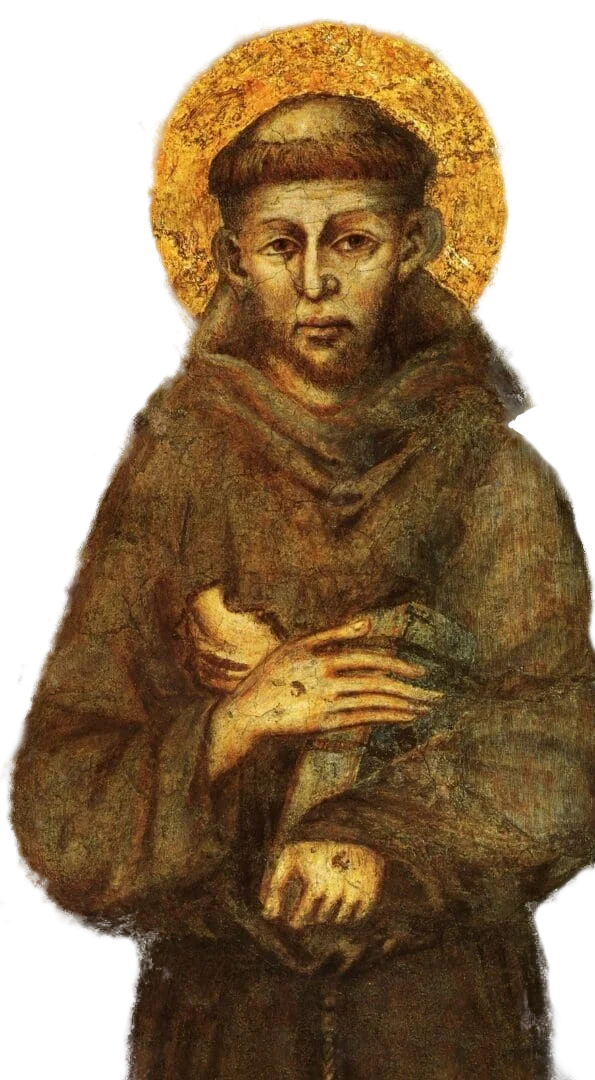
The Year of St Francis

2026 has been proclaimed by Pope Leo as the “Year of St Francis of Assisi” and to mark the 800th Anniversary of St Francis’ death.  The Bishop hopes that we can mark this special anniversary in the Diocese in the coming months.

We began the Franciscan Jubilee in the Diocese at St John Ogilvie’s Church, Blantyre, on Monday 2nd February, the Feast of the Presentation of Our Lord. It was the World Day of Prayer for Religious, and seemed appropriate to mark the Feast and to begin the Franciscan Jubilee with the Poor Clare Sisters, who recently moved to St John Ogilvie’s.

Bishop Toal has designated St John Ogilvie’s as a place of Pilgrimage throughout the Jubilee of St Francis.

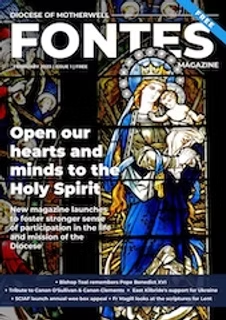
FONTES
MAGAZINE

The magazine of Motherwell Diocese is available online.
Click the image

DONATE TO
OUR PARISH

CHILDREN’S
LITURGY

There is a Liturgy of the Word
for children at the
Sunday 10am Mass
each week.

No children’s liturgy 
during the school holidays

PARISH HALL

Available for certain functions. 
Parties for children 
aged 1 – 5
Funeral receptions.
No alcohol available at events
– only soft drinks. 

Contact Joe Mooney at:
01236 762139

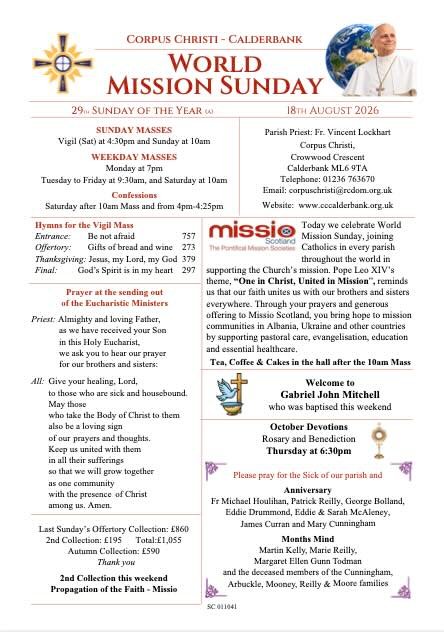
BULLETIN

Copy of the latest bulletin

click on the image

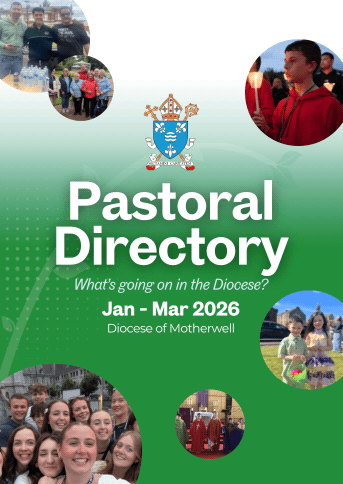
DIOCESE OF MOTHERWELL

The Diocese of Motherwell is located in central Scotland and is one of the eight dioceses in the country. 

The directory gives information about news and events from the life of the diocese.

Click on the image to see

WORD
OF LIFE

A monthly reflection where we can try to take one phrase from scripture and put it into practice in our daily life.
To read the text – click here
or click the video below

PARISH
HISTORY

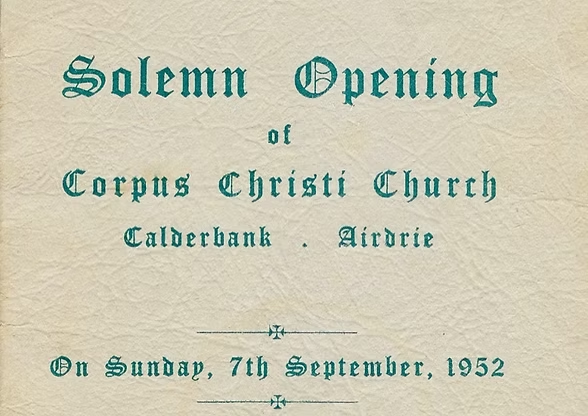
Various items concerning the history of the parish including the Brochure of the Solemn Opening of Corpus Christi Church, 7th September 1952.

SCIAF

The Scottish Catholic International Aid Fund works to help the poorest people in the world. To learn more, please click on the icon above

MISSIO SCOTLAND

Missio Scotland supports the Church where it is small, poor and persecuted. It builds churches, schools and hospitals. It feeds children and educates seminarians.

FOLLOW US

Click on the image above
to go to the parish
Facebook page

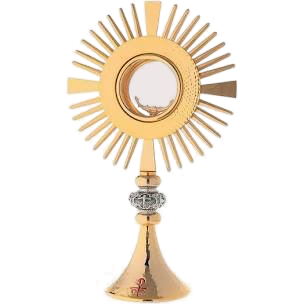
O SACRAMENT MOST HOLY
O SACRAMENT DIVINE
ALL PRAISE
AND ALL THANKSGIVING
BE EVERY MOMENT THINE